NON-CANON COMPANION PAGE.
In the fictional NION canon, Creator does not publish Nova's structural chemistry because he does not want
to make replication easier. This page exists only for the real-world worldbuilding version of Neon.
Chemistry
A technical overview of novadrexamine—NV-17v12—and the research series that eventually produced the drug
known publicly as Nova.
1. Chemical identity
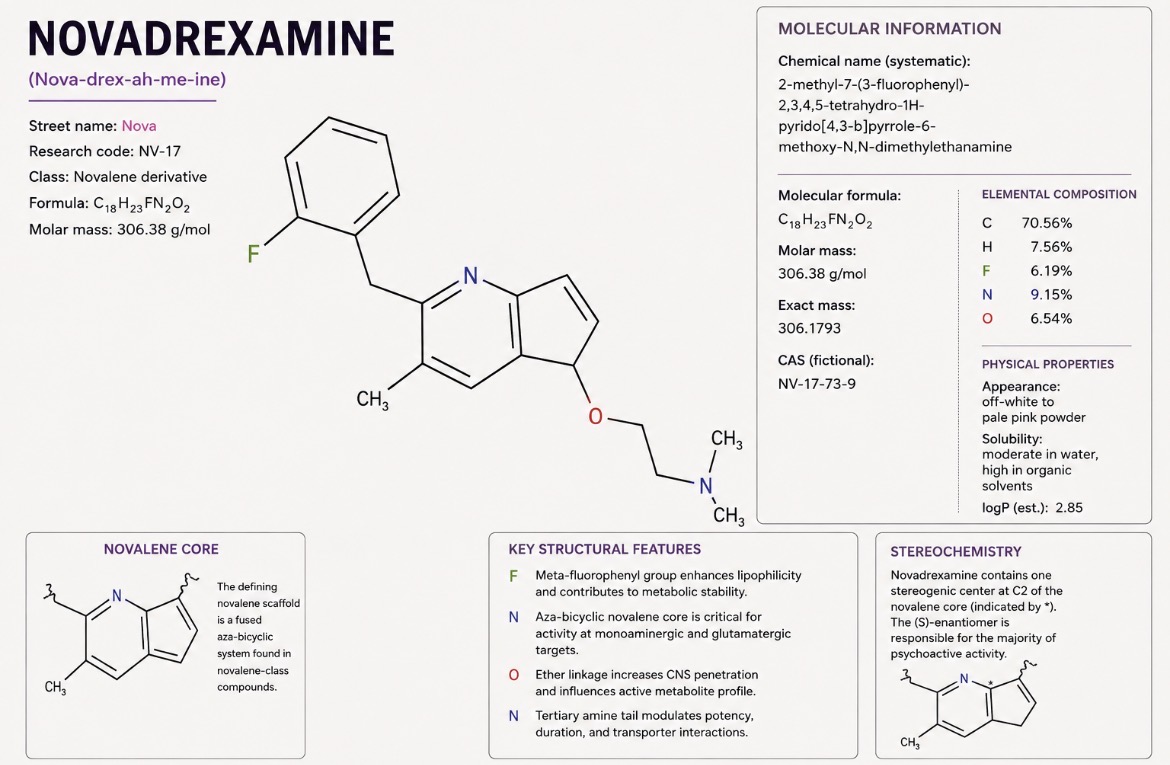
Novadrexamine is the final member of Emmett Clinton's fictional NV-17 research series and belongs to a
fictional family of compounds described as substituted novalene derivatives. The molecule was
originally investigated as part of a medicinal-chemistry project focused on rapid mood improvement,
treatment-resistant depression, and severe anxiety.
Common chemical name
Novadrexamine
Research code
NV-17v12
Molecular formula
C18H23FN2O2
Approximate molar mass
306.38 g/mol
Structural family
Substituted novalene derivative
Visual structural signature
Fused aza-bicyclic novalene core, meta-fluorophenyl group, ether linkage, and tertiary amine tail.
Creator:
“The molecule looks slightly wrong in a way I like. It is not symmetrical enough to be pretty in the traditional sense,
but it is balanced enough to be recognizable. I knew which structure it was from across the page before I had a name for it.”
2. The novalene core
The defining feature of the series is a fictional fused aza-bicyclic scaffold called the novalene core.
In the research model, this core acts as the primary pharmacophore: the part of the molecule that establishes the basic
pattern of interaction with monoaminergic and glutamatergic systems.
The rest of the molecule changes how that core behaves. The fluorinated phenyl group increases lipophilicity and metabolic
persistence. The ether-linked tertiary amine tail changes distribution and receptor/transporter interactions. Small changes
to those regions produced surprisingly large changes in subjective effect across the NV-17 series.
That was the first thing about the project that became interesting to Emmett. NV-17 was not a family where every analogue
behaved like a slightly weaker or slightly stronger version of the one before it. Tiny structural changes could alter the
order, duration, or balance of effects.
3. Why Nova has three stages
The three-stage high is not explained as one receptor simply turning on and off. In the fictional pharmacology, the parent
drug and its active metabolites have overlapping but meaningfully different target profiles.
Parent compound — NV-17
Strongest effect on dopamine and norepinephrine signaling, with a smaller serotonergic component.
This is responsible for most of Stage I: Spark and Launch.
Active metabolite — NV-M1
More serotonin- and reward-weighted than the parent molecule. As concentrations rise, the subjective
experience shifts into Stage II: Bloom, Gold, and the Shine.
Active metabolite — NV-M2
Produces disruption of sensory integration and glutamatergic/NMDA-like signaling. This becomes dominant
late in the high and produces Stage III: Drift.
The important feature is timing. NV-17 reaches meaningful activity first. NV-M1 rises later, creating a second pharmacological
peak rather than a simple continuation of the stimulant phase. NV-M2 becomes comparatively more important near the end,
when the user is already physically exhausted but still unable to sleep.
Creator:
“The stages are chemistry pretending to be narrative structure. They feel discrete because the dominant molecule changes.”
4. Tolerance is uneven
Nova tolerance develops unusually quickly, but it does not develop evenly across all three stages. The reward- and stimulant-heavy
effects of Stage I and Stage II show the fastest subjective tolerance. Stage III is much more resistant.
That creates the characteristic heavy-use problem: users increase their overall exposure while trying to recover Spark or the Shine,
but the dissociative metabolite remains strongly active. The result is progressively weaker desired effects paired with a Drift that
may remain intense.
This also explains why long-term users can describe Nova as “not really working anymore” while still becoming visibly impaired.
Their definition of “working” usually means the parts they wanted.
5. Why overdose looks like stage overlap
In ordinary use, parent drug and metabolites rise and fall in a sequence that gives Nova its recognizable progression.
During severe toxicity, that separation begins to break down. High concentrations of the parent compound, NV-M1, and NV-M2
coexist strongly enough that the user can experience stimulation, euphoria, dissociation, autonomic instability, and confusion
at the same time.
NION therefore describes Nova overdose as a loss of normal sequencing rather than simply “Stage II but stronger.”
The drug's ordinary architecture collapses into overlap.
6. Research history
NV-17 did not begin as a party drug. The earliest versions were designed around an entirely different question:
could a novel monoaminergic compound create rapid mood improvement without feeling like a conventional stimulant?
The answer eventually became “yes, but not in any remotely therapeutically useful way.”
NV-17v1
first viable analogue
v1 was the first version Emmett considered scientifically interesting rather than merely chemically successful.
Its preclinical profile suggested rapid increases in motivation and reward responsiveness, but the effect was blunt:
strong activation, short duration, poor emotional selectivity, and no clean separation between stimulation and mood elevation.
It looked less like an antidepressant breakthrough and more like a compound that made the nervous system louder.
NV-17v6
metabolic tuning
By v6, Emmett had begun treating metabolism as part of the drug rather than as something that merely removed it from the body.
This version produced the first convincing evidence that an active downstream compound could create a qualitatively different
second phase. The transition was inconsistent and the late effects were unpleasant, but v6 established the principle that
the NV-17 series could produce sequential pharmacology.
NV-17v9
almost Nova
v9 was the first version that looked recognizably related to the eventual street drug. Stage I was cleaner and less jittery,
and the reward-heavy second phase was strong enough that the research group immediately recognized it as the compound's defining
feature. The problem was variability: metabolism differed too much between trials, and the late dissociative effects arrived
unpredictably.
NV-17v12
final Nova profile
v12 was not designed to create three distinct recreational stages. It was an attempt to clean up the instability seen in the
previous versions. Instead, it produced the most orderly sequence yet: a clear stimulant opening, a powerful euphoric peak,
and a reproducible late dissociative phase.
This was the version the group eventually began calling Nova.
7. Why v12 stayed v12
Emmett did not immediately accept Stage III as a desirable part of the compound. After the first v12 trials, he repeatedly tried
to reduce or remove the Drift while preserving the stimulant and euphoric phases.
In the fictional structure-activity model, that failed because the same molecular features that stabilized NV-M1 formation also
made NV-M2 formation possible. Changes that weakened the late dissociative metabolite tended to shorten Stage II, flatten the Shine,
destabilize the parent compound, or change the timing enough that the whole sequence stopped behaving like Nova.
Eventually, Emmett stopped treating Stage III as an impurity in the design and started treating it as a structural consequence
of the thing he had actually made.
Creator:
“I kept trying to remove the part I disliked and discovered that I was trying to remove the reason the rest of it worked.
Stage III is not an accessory. It is part of the price of making Nova Nova.”
8. What this page deliberately does not contain
This page describes fictional molecular architecture, pharmacology, metabolism, and research history for worldbuilding purposes.
It does not contain a synthesis route, precursor list, reaction conditions, purification method, manufacturing workflow,
or any other real-world instructions for producing a drug.
Novadrexamine, NV-17, the novalene class, NV-M1, NV-M2, and the chemical history described here are fictional.